
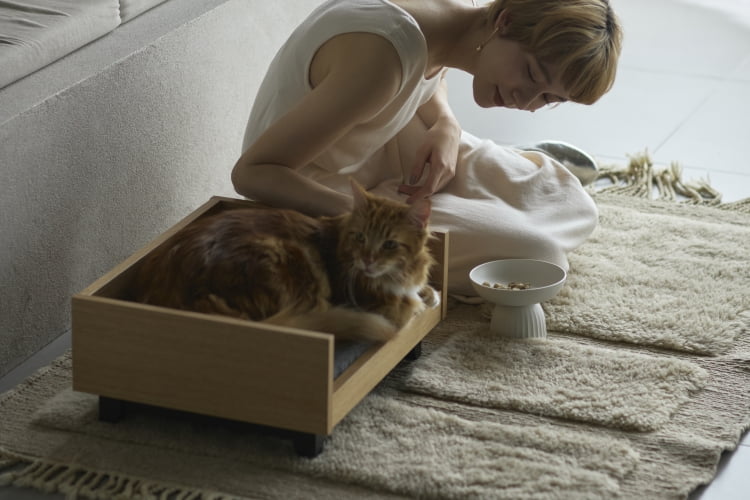
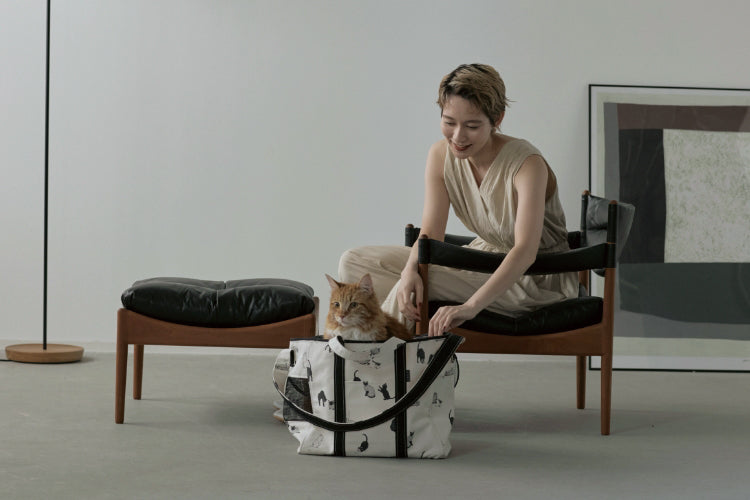
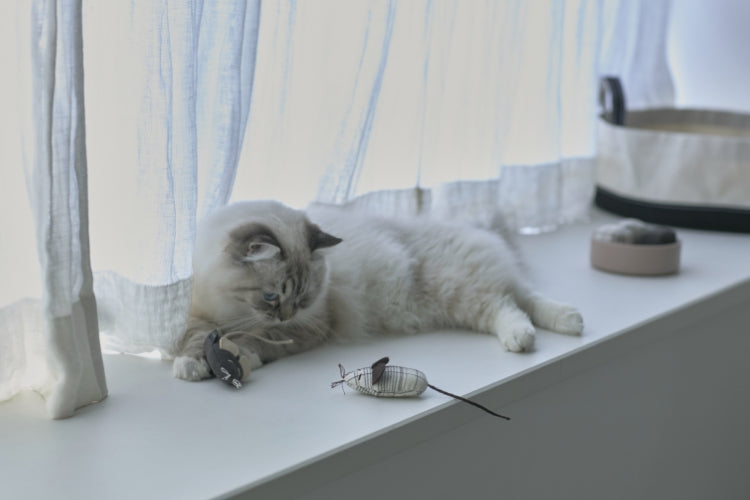
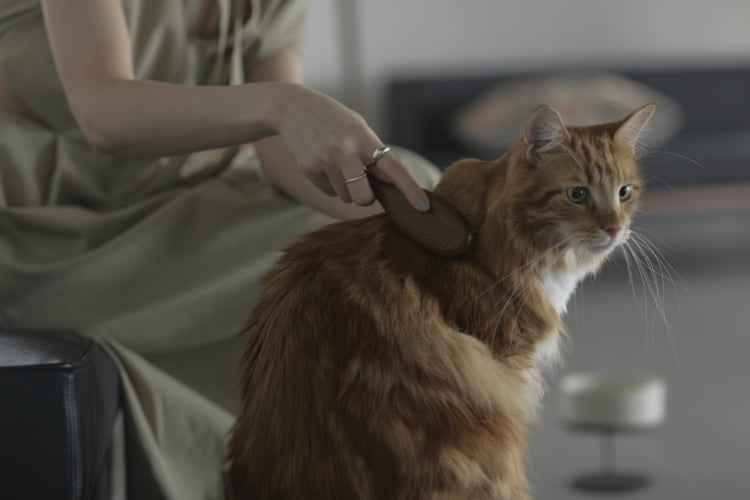

My Cat, My Home #10 | The warmth of yarn, and the presence of cats.
Kari Ishikawa is a fiber artist who sews yarn together on a sewing machine to create the unique, endearing creatures she calls "yarn animals." In 2020 she moved to Yamagata, where she lives with three cats in an atelier and home surrounded by nature. We asked her about what lies behind her work, her life with her cats, and the space where the warmth of wood, clay and cloth comes together. Nine of Kari Ishikawa's works are also featured for a limited time on a special page. Small animals born from yarn, quietly adding a story to a home shared with cats.
-
Profile

Sudachi, Kiki and Jiji. Three cats, three kinds of charm
Kari lives with three cats.

Sudachi, a male Bengal known to everyone as Su-chan, is six years old and the mood-maker of the house. He is friendly and loves visitors. When he is hungry he knocks things over to get attention — clever, and a bit of a glutton.

Kiki, a five-year-old tortoiseshell girl, has the air of a princess. She is particular about food, eats little and stays slim. She carries a toy over in her mouth, waits for it to be thrown, then brings it back — again and again, almost like a dog.

Jiji, a black cat also aged five, is deeply affectionate with family. With strangers he is shy, and he rarely shows himself when there are visitors — which is why the people around Kari call him the "rare character."
All three have different personalities and different ways of keeping their distance, and the differences themselves are what make them dear. Their presence is always close to Kari's life and her work.
Each meeting widens the life around it
Kari met Su-chan about a month after moving to Yamagata.
She was out driving toward Fukushima when she saw him on the adoption site Pet no Ouchi. The listing said only that he was a three-month-old male, showed a photo of his face, and carried the words "urgently seeking."
She got in touch, a reply came straight back, and she changed her plans on the spot to go and meet him. She had gone expecting a brown tabby boy, but what came racing out onto the veranda was a tiny leopard-spotted kitten.

The listing had deliberately avoided saying "Bengal," as a precaution against pet crime. Su-chan had struggled with the dogs already living in the house and had fallen ill, so a new home was being sought urgently. Kari had felt she would welcome any cat that came her way, and she took him home to Yamagata that day, where he became family.
She met Kiki and Jiji through an adoption listing on Jmty, posted by someone doing cat rescue work in Yamagata — two sisters.
She had planned to take only one, but faced with two adorable sisters who were so close to each other, she could not choose between them, and both went into a trial stay. Both stayed for good.
Taking in Kiki and Jiji led to Kari learning about rescue work from the woman who had been fostering them. She learned how TNR works and about subsidies for spaying and neutering, and began arranging surgery and new homes for the cats who appeared on her own property.
Meeting one cat leads to a new way of facing the next life. There is a gentle circulation like this running through Kari's days.
Cats, settling naturally into an atelier
Kari works as a fiber artist, making something new almost every day.
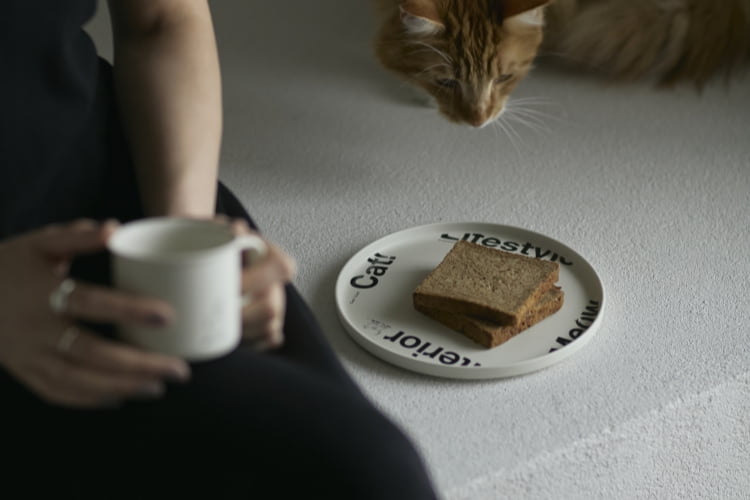
The cats often come to get in the way while she works. But for her that is a very happy sort of problem.
Animals born from yarn, collected objects and vessels, handmade things lined up together — and among them, the cats settle in so naturally they might be part of the work.
Still, Kari says:
"Frustratingly, none of my pieces can compete with how cute the cats are."
Footsteps, a gaze, a whimsical interruption — right beside the making. Out of days like these, her work comes into being, little by little.

Light at the window, the voices of birds. Cats halfway up a mountain
Kari's house sits halfway up a mountain.
Birds and insects crossing the sky outside, grass and trees moving in the wind — the cats spend their days watching all of it intently.
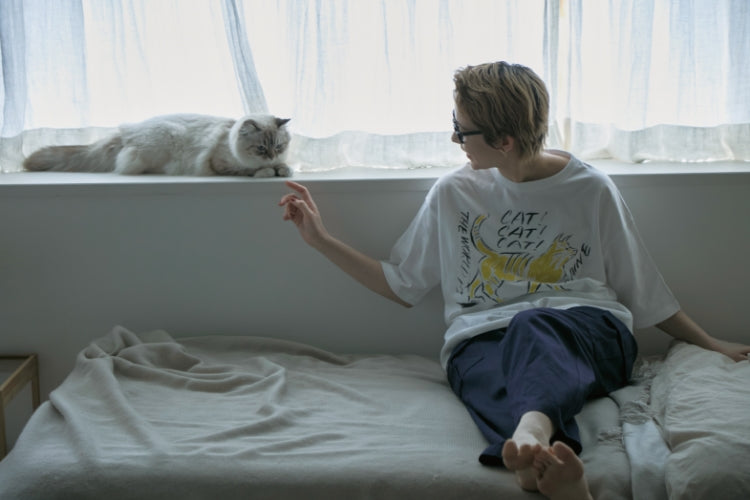
Morning light pours in through the large east-facing windows, and the cats sunbathe with obvious pleasure. People often compliment the condition of their coats, and Kari says, "Perhaps that is thanks to all the sunshine."
Light at the window, leaves swaying, the sense of birds and insects nearby. For the cats, every day may be a stretch of time in which the outside world and the inside of the house are loosely joined.

Because they have no words, you look more closely
What Kari values most in living with cats is sensing how a cat feels when it cannot speak.
"Our own cats are easygoing, so there is not much to worry about — but doing rescue work, I have come to feel this is truly the most important thing."
Cats who have just been taken in often cry through the night. Much of it comes from stress and anxiety. Closing the distance a little at a time each day and removing that anxiety is, she says, the shortest route to a cat growing used to people and to a new place.
Right now Kari also has Muta, a cat looking for a home.

Muta is a brown tabby and white boy who used to live outside the atelier. At first he hated being touched and was so wary he hissed at everyone.
Even so, over a long stretch of time the distance closed little by little, and today he adores people and loves being held.
Because he is FIV positive he currently lives in a separate room, to prevent fights. Getting along with other cats looks difficult for him, so Kari is looking for someone who could take him as an only cat.
(If you would like to adopt him, please get in touch through Kari Ishikawa's Instagram.)
What is he thinking? What does he like, and what does he dislike?
Because they cannot tell you, you watch carefully. You do not rush; you face them slowly. That kind of gaze lives quietly in Kari's days with her cats.
Wood, clay, cloth. A house where the warmth of handwork gathers
What Kari loves are things with warmth in them.
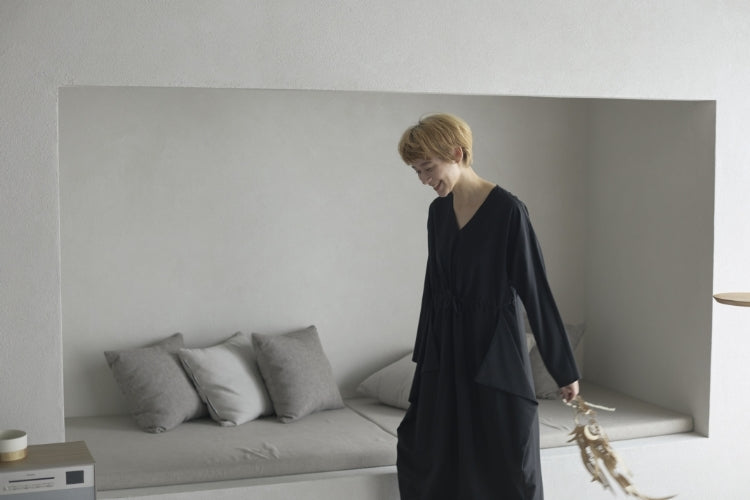
Almost all of her furnishings are made of wood, clay or cloth. The gentle texture of natural materials, and objects that carry a sense of the person who made them, are what shape her atelier and home.

A particular favorite is the wooden animals made by Christian Werner at a toy workshop in the village of Seiffen, Germany. She discovered them through the NHK program "Sekai wa Hoshii Mono ni Afureteru" and has been adding a few every year since. Since it is obvious the cats would get at them, they are kept safely inside a display case.

Favorite pieces are displayed on shelving built for her when the house was renovated. Among them, the bird whistles by Vygantas and Rūta — kept together as a "Lithuania series" — are especially precious. She is drawn to forms that carry the warmth of the maker.

A wooden display case placed to divide the living-dining area from the kitchen holds her most treasured vessels. Old Sông Bé ware and a chicken figure found in Vietnam, Romanian antiques, pieces by makers she loves — simply looking at them is one of her pleasures.


The dining table is an English antique. It is a little large for two people, but it suits a house with as many visitors as Kari's. Her favorite detail: the legs look exactly like a cat's paws, right down to the claws.
Things made by hand, things met while traveling, things gathered slowly over time. The presence of the cats layers over all of it, and a space that could only be Kari's takes shape.

The rich time the cats have given her
Around the same time she moved to Yamagata, the pandemic began.
The wedding she had planned was called off. Going home to her parents became difficult, and she could not see friends. With the state of emergency in place, making new friends in Yamagata was hard too.
It was during that low, difficult period that she met Su-chan.
"From that moment the clouds lifted all at once, and every day became enjoyable and full."
Since the cats arrived, Kari's life has become thoroughly cat-centered. Wanting them to stay healthy for as long as possible, she gave up the scented things she used to love — diffusers, fabric softener — and now chooses plants that sit out of reach, hanging, or mounted on the wall.
The cats have also brought many connections. When she meets cat-loving friends, almost every topic is cats, and still the conversation never runs out; she feels the depth of a cat's appeal every time.
Kari says that when she prays at a shrine she used to have a mountain of wishes. Now, the first thing that comes to mind is her cats' health.
"More than anything, I am glad that such a presence exists in my life. I want to keep treasuring the time we can spend together, so that I can give back to the cats the happiness they have given me."

The &CAT water bowl, and the cats' drinking time
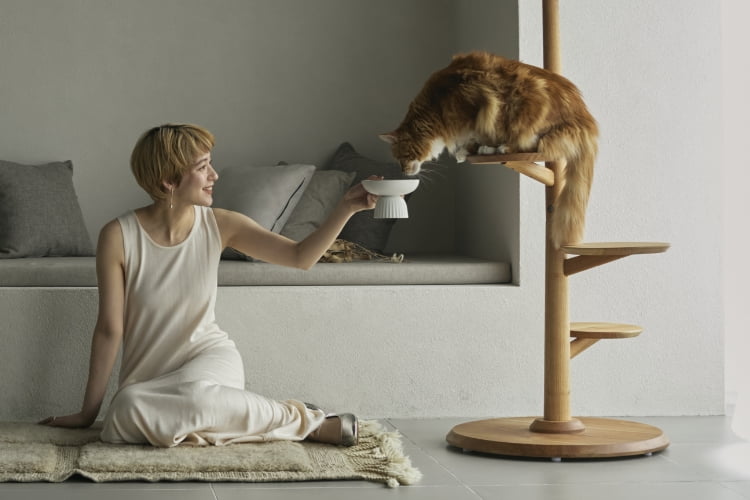
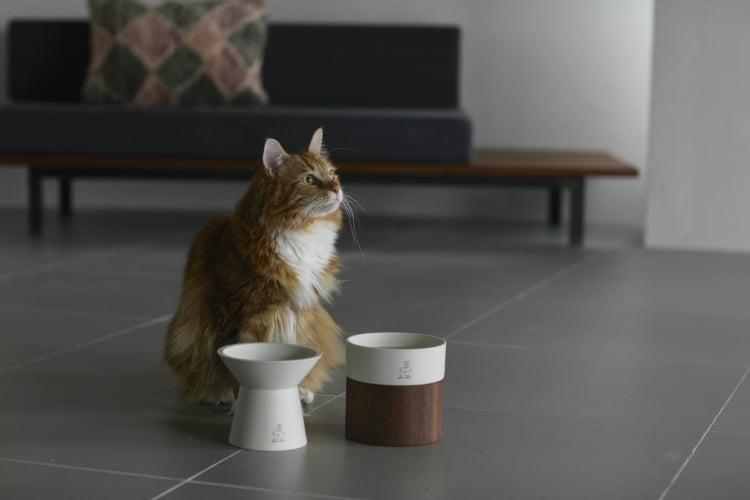
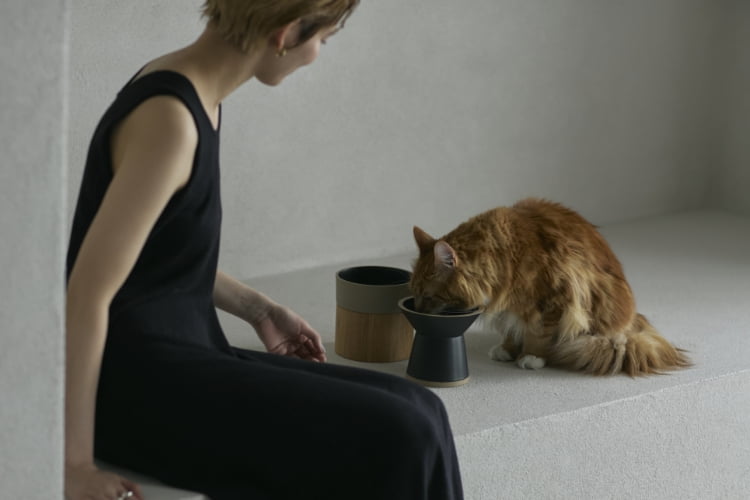
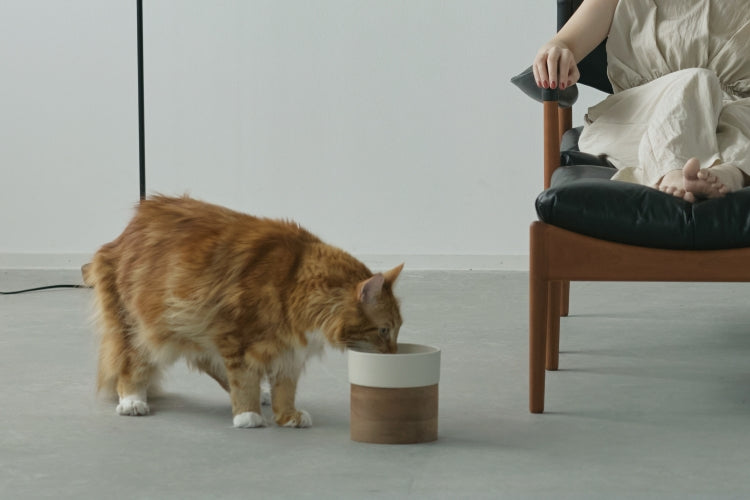
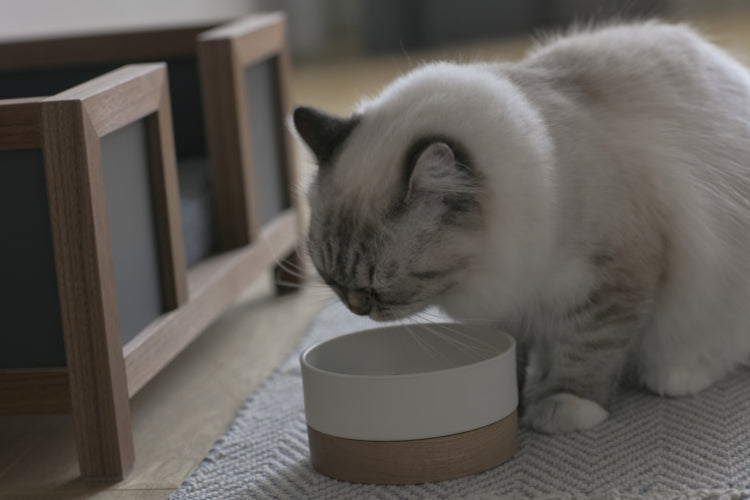
What Kari chose from &CAT is "HM BOWL," a water bowl combining Hida woodwork with Mino ware.
The warmth of the wood and the smooth quality of the Mino porcelain sit naturally in her home. It holds plenty, which is welcome in a multi-cat household, and the cats seem to find it easy to drink from — they gulp it down.
The presence it has as a vessel, and the ease of use that fits into a cat's daily life.
In Kari's atelier, where the warmth of wood, clay and cloth gathers, the &CAT water bowl quietly belongs.
Photo: Ririka Hakoishi
Instagram → @ciar_rrk_

Work with a story, for a home shared with cats
To mark this article, &CAT is featuring nine of Kari Ishikawa's works for a limited time on a special page.
Unique, endearing "yarn animals," born from yarn sewn together on a sewing machine. Each has its own expression and bearing, holding the warmth of Kari's handwork and her gentle regard for animals.
Small presences that quietly add a story to a room shared with cats.

Kari Ishikawa's work can be seen from Saturday, June 6 to Sunday, June 14, on the &CAT special page.
View the special page here

Information | Group exhibition featuring Kari Ishikawa
Kari Ishikawa takes part in the exhibition "Katakute Yawarakai (Hard and Soft)" at TOKYO FANTASTIC 201.
A collection by ceramic artist Sawa Isshiki and fiber artist Kari Ishikawa.
An exhibition in which hardness and softness — the character each material carries — answer each other.
If you are nearby, please do stop in.
"Katakute Yawarakai (Hard and Soft)"
Collection by Sawa Isshiki & Kari Ishikawa
Dates: Saturday, June 13 – Tuesday, June 30, 2026
• Closed every Wednesday.
Venue: TOKYO FANTASTIC 201
3-16-6-201 Minami-Aoyama, Minato-ku, Tokyo
Open: 12:00–19:00
Closed: Wednesdays
Instagram @tokyofantastic201
Participating artists:
Sawa Isshiki (ceramics) Instagram @sawaisshiki
Kari Ishikawa (fiber art) Instagram @_kari_ishikawa